
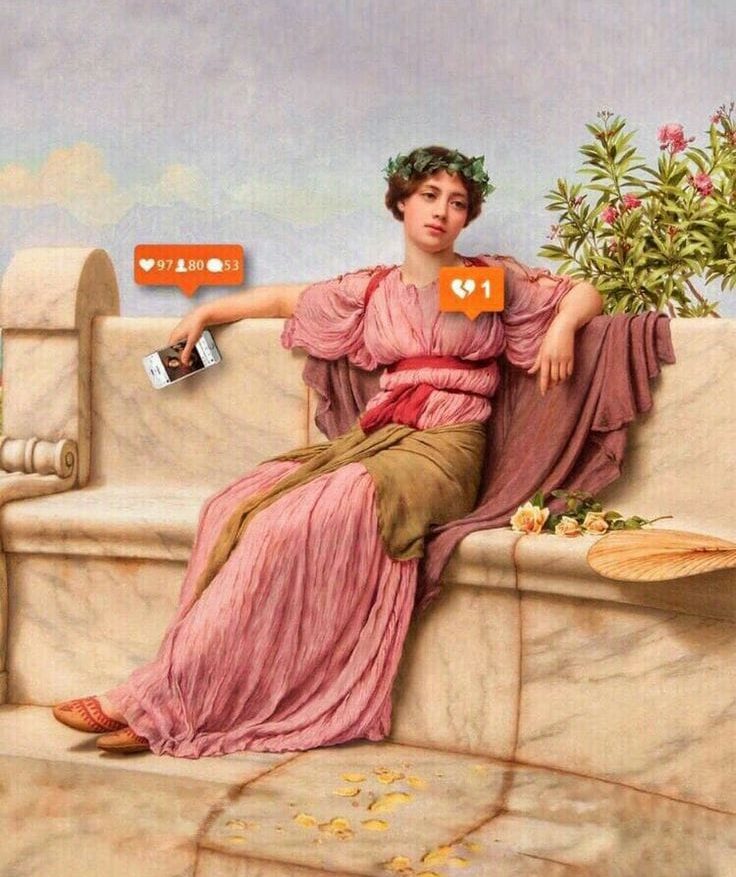
Human courting strategies have evolved over time, and online algorithmic spaces have become the new social battlegrounds. Many people claim that this is the worst era to date and blame social media for this. I believe that this era is different from no other. I also believe that social media is not to blame for the mess that is modern dating, but American Imperialism. This is evident in how most of our social (media) behaviours echo those of a fictional character created over 100 years ago. And just like The Great Gatsby, we are victims of the American Dream.
I post something for her to like, or even possibly respond to, and while I can never know if she posts anything specifically for me, it doesn’t stop me from clicking on that little heart at the bottom corner of the screen. This is akin to Gatsby hosting extravagant parties in hopes that the object of his desire will walk in one day. Social media has allowed us to host digital “parties” in hopes of forcing a passive interaction that will hopefully become something greater, instead of initiating a private conversation and exposing ourselves to possible rejection.
We make use of so many “low risk” strategies in order to maintain plausible deniability and protect ourselves from being rejected, embarrassed, or heartbroken. What matters more than actually building a relationship with someone is maintaining the image that you have curated for yourself. Gatsby was obsessed with making sure that he was perceived as a member of the aristocracy, so he made sure no one got too close, possibly preventing him from ever making a real connection with Daisy. We do the same thing every time we post. The like button, the story reply, the carefully timed comment; these are all versions of Gatsby’s parties, thrown not because we want the whole world to attend, but because we want one specific person to wander in.
This same logic explains why proximity, even fake proximity, feels like intimacy now. Gatsby bought a house across the bay from Daisy’s, close enough to watch the green light at the end of her dock every night, close enough to convince himself that he was already part of her life. Social media gives everyone that house. Following someone, watching their stories, knowing what they had for breakfast or where they went last weekend, creates an illusion of reachability and closeness that has nothing to do with an actual relationship. We mistake access to someone’s feed for access to their life, the same way Gatsby mistook a view of Daisy’s dock for a place in her world.
That illusion of closeness easily turns into something darker: a kind of low-grade cyberstalking that creates parasocial fixation. We want people, or the idea of people, not because we know them, but because of what they represent. A stranger’s curated feed becomes a symbol of a life we want, a status we’re chasing, and the person themselves becomes almost incidental. This too, is very Gatsby: Daisy was never really the point. She was the proof that a poor boy from North Dakota had made it, a green light stitched out of old money and belonging. When we fixate on people we barely know, we are often fixating on what having them would say about us.
To play this game at all, social media demands hyper-visibility. Every private moment is pressured into becoming a post; the version of your life that doesn’t get shared starts to feel like it didn’t count. And because visibility only works if someone sees it, we perform a kind of vulnerability designed less for genuine connection and more for reach. We share just enough of ourselves, arranged in just the right way, to build a social echo chamber loud enough to reach the one person we actually want to reach, and we sacrifice real privacy to do it. Gatsby’s parties worked the same way. They were extravagant, generous, seemingly open to anyone, but their entire purpose was to be loud enough that word would eventually reach Daisy. Openness, for both Gatsby and for us, is rarely about openness. It’s a broadcast with one intended recipient and a room full of collateral witnesses.
Because so many people are running the same strategy at once, courtship behaviour has flattened into shared scripts: the same memes, the same trends, the same transactional rituals repeated across millions of profiles. Everyone is pushed toward an almost identical performance of desirability, because the algorithm rewards whatever performs, not whatever is honest. In a strange way, this mirrors the sameness of the world Fitzgerald describes, a world where everyone at Gatsby’s parties dresses well, drinks well, and gossips well, without any of them really knowing their host or each other. We are gossiping about each other’s carefully staged lives, trading in the same handful of gestures, because the platform has taught us that this is what courtship looks like now.
None of this is really social media’s fault, though. Social media is only the venue. The real engine underneath it is the same one that built Gatsby. America is the most powerful imperial force in the world, and the media is one of its greatest weapons. The American Dream, that promise of self-invention through wealth and status, has been exported to every corner of the globe, and social media is simply the fastest delivery system it has ever had. Everyone alive today, whether they’ve ever set foot in the United States or not, has been drawn into the same individualistic pursuit of wealth and status that consumed Gatsby. This shows up in who we choose to pursue and in the methods we use to pursue them: the flexing, the curation, the calculated distance, all of it aimed at proving we belong to a life worth wanting.
But material success cannot erase social boundaries, no matter how convincingly it’s staged. Gatsby’s mansion, his shirts, his parties, none of it could turn him into old money or win him a future with Daisy; it only ever bought him proximity to a life he was never fully let into. We do the same thing on our own screens. Obsessed with our images, we project still, temporary versions of ourselves to people. Just like Gatsby, we mistake the performance of having arrived for the thing itself. And just like Gatsby, we keep reaching for that green light anyway, because the alternative, the private conversation, the real exposure, the actual risk of rejection, is so much harder to post.
