
There’s a sweetness to [the Iman] the belief that you and I have, my question is how many of you have tasted that sweetness?
Barakat (2020)
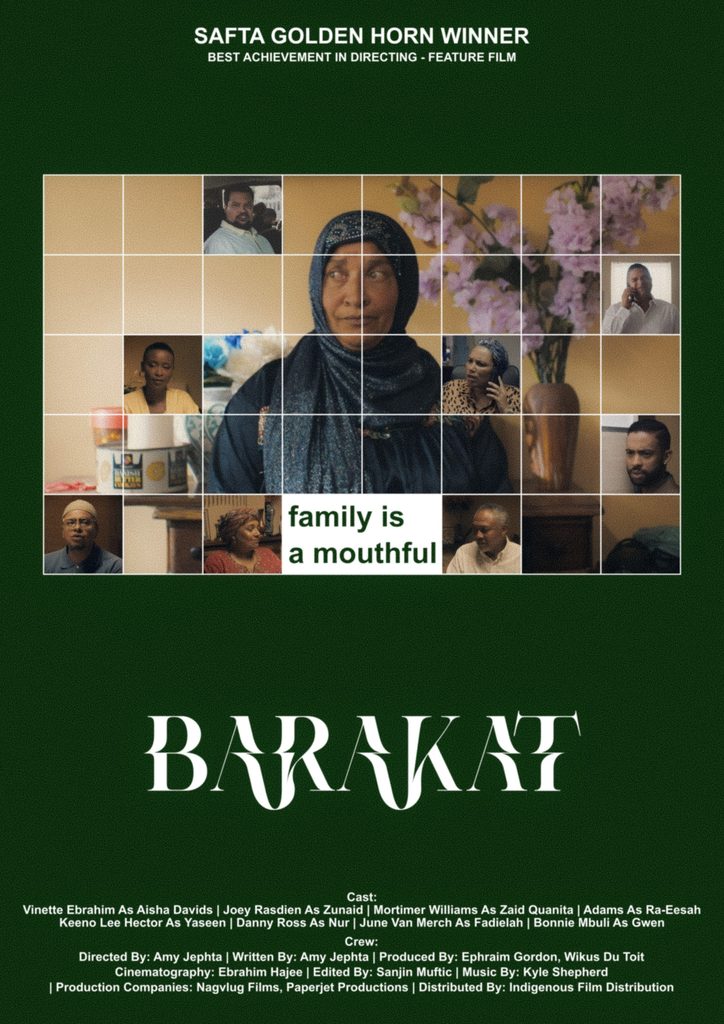
Director, screenwriter, and playwright Amy Jephta gives us a family dramedy steeped in themes of grief, religion, and culture. Barakat is an Arabic word that translates to English as blessings, a fitting title for a film this sentimental about its subjects. We follow a family as they gather for Eid al-Fitr at the behest of their ageing, widowed mother.
Yellows, oranges, and reds dominate the screen in this heart warming feature with a striking visual language. The opening sequence sets the tone for how focused the cinematography and editing of this film will be for the rest of its runtime. Director Amy Jephta, cinematographer Ebrahim Hajee, and editor Sanjin Muftic work together to put us through a sequence of inspired camerawork and editing depicting a family growing together over the years. We see the passing of the father, the funeral, and the tearing apart of a grieving family bickering amongst themselves, shown as the camera rotates around their dinner table. The end of this hypnotic sequence snaps us back into the present day, and the story begins from a sombre note that will eventually work its way into the viewer’s heart through striking visuals and the performances to match.
A star-studded cast elevates this endearing story with performances well balanced between loaded emotion and comedic relief. The beloved Vinette Ebrahim plays the ageing matriarch, Aisha, with an elegance notably sharpened by experience. She is the anchor of the entire film and her presence steals the show at every stop. Not to the discredit of her cast members, who all had their moments of brilliance throughout the film. Aisha gathers her family over Eid to inform them of her engagement to Albertus, a kind hearted doctor played by the great Lesley Fong. The Doctor is met with hostility by the four brothers: Zaid, a Johannesburg based businessman with a strident personality, played by Mortimer Williams with a firm subtlety, switching seamlessly between stern and comedic; Zunaid, the married and seemingly conventional brother, played by Joey Rasdien, who seems to shine in the more emotionally charged scenes; Nur, the flamboyant womanising brother, played by Danny Ross, gives us a contained, but chaotic performance, raising the energetic beats of the film, and Yaseen, the outcast, nervous-wreck brother, is played by Keeno Lee Hector with the adorable charm of a little brother. Aisha finds support and acceptance in Ra-eesah, Zunaid’s aggrieved, pregnant wife, played by Quanita Adams, who shines through even in the little screentime she’s given, and Gwen, Zaid’s girlfriend portrayed by Bonnie Mbuli, whose character seems to feel othered because of her and the family’s cultural differences.
Barakat is a simple and relatable story that the average person can relate to because of the universality of the themes. The story is structurally and narratively very derivative of its genre, but make no mistake, this film – in the context of its making – is a giant breath of fresh air. The simplicity of this story avoids the common trope in South African film and television of tokenising and negatively generalising the Coloured community – especially those of the Cape Flats. The constant cycle of negative representation tends to sideline the humanity of this community, but what Barakat manages to do is bring that humanity back to the foreground and remind us that they are human beings who live, love, and grieve like anyone else. Fair arguments can be had about the negative implications of neglecting to acknowledge the very real socio-economic problems in the Cape Flats, but, again, in a country that has that aspect of the Cape Flats perpetually reported and represented, I highlight a quote from the film; “There’s a sweetness to the belief that you and I have, my question is how many of you have tasted that sweetness?” I hope in this film’s case we can see the value in tasting the sweetness.
The closing scene in Barakat is a shared dinner table – a beautiful scene. In addition to the direct translation of blessings, Barakat also refers to the Cape Malay (and broader Islamic traditions) tradition of sharing treats, cakes, and food in a paper bag with neighbours and family after (often) religious events, in the effort of sharing blessings. Let us receive this film as said blessings.
