
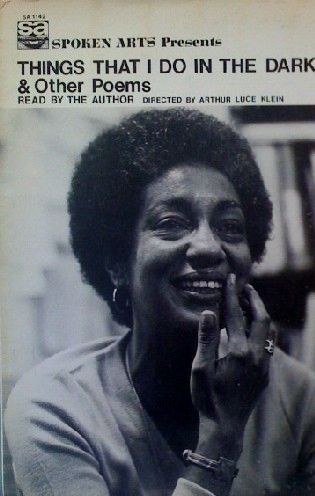
June Jordan’s Things That I Do in the Dark is an intimate collection of poems. It challenges readers to confront the tensions within themselves and to examine, as the title suggests, the parts of their lives they keep hidden, secret, or reserved for their most intimate spaces.
Published in 1977, the collection brings together poems written between 1954 and 1977. It captures more than two decades of stories and political realities, working almost as a historical record. Jordan explores sexuality, grief, oppression, capitalism, war, and confrontation of power. She introduces the collection’s central concerns from the beginning. In “These Poems,” she writes:
These poems
they are things that I do
in the dark
reaching for you
whoever you are
and
are you ready?
The poem ends with:
whoever you are
whoever I may become.
Jordan reaches toward an unknown reader while also imagining the person she may become through the act of writing. The poems are private, but never isolated. They ask what it means to reveal yourself and demonstrate that intimacy can be a form of political connection and claim.
Jordan does not simply write about oppression; she creates a language that defines instability and turbulence. Her poetry breaks grammar, interrupts syntax, and uses deliberately fractured speech. These disruptions can feel difficult at first, but they somehow make the poems more personal. Rather than presenting her experiences as neat, structured or complete, Jordan circles around the English language to reflect the confusion and intensity of her (and our) lived reality.
In “New Like Nagasaki Nice Like Nicene,” Jordan writes about Christian morality, capitalism, and war. Her use of Nagasaki, a Japanese city with a significant history of Christianity and association with the violence of the Second World War, clearly represents the contradictions that shape our lives.
blood stains Union Street in Mississippi
so now there will be
another investigation to see
whether or not
the murder of the running young girl
by drunken whiteboys
was a federal offence
(May 1, 1970)
In another poem on power and violence, Jordan writes on the social collapse and pain in Alabama and Canarise.
the house on fire/
poison waters/
earthquake/
and the air a nightmare/
turn
turn
turn around the
national gross product
growin
really gross / turn
turn
turn the pestilence away
the miserable killers
and Canarsie
Alabama
people beggin to be people
Their pain bleeds into her home, into her being and into her writing. In a similar way that she did not live in Apartheid South Africa, but wrote poems and spoke of it, Jordan’s activism reached far beyond what was directly in front of her. Although the poem names specific places, its cry for people to be fully recognised and heard across different histories and geographies: Algeria, Argentina, the Congo. The poem insists that the struggle to become fully human is never confined to one place or one historical moment.
Jordan is searching for a new existence. Through poetry she expresses deep frustration, and longing. She longs for a life that is less turbulent and more humane.
The book’s four sections trace movement through family, desire, political violence, and the relationship between personhood and language.
1. “For My Own”
The first section, “For My Own,” includes poems like “For My Mother” and “Uncle Bullboy.” These poems turn toward family history, loneliness, and grief. They explore the pain of witnessing people we love descend into profound emotional darkness.
In “Uncle Bullboy,” Jordan writes:
His brother dead from drinking
Bullboy drank to clear his thinking
saw the roach inside the riddle.
She reflects on her uncle’s attempt to make sense of grief through drinking. Grief is a disturbing foece that refuses to remove itself from you – no matter the time, circumstance or location, it finds a way to pull you back in and drown you in it.
2. “Directed by Desire”
The second section, “Directed by Desire,” includes poems such as “The Wedding” and “Lullaby.” As the title suggests, these poems explore desire and its depth. Jordan writes of love as something that requires courage, and shows clear admiration for it.
In “The Wedding,” she writes:
the earlywed Tyrone
and his Dizzella
brave enough
but only two.
The poem is tender and vulnerable. The couple’s bravery is simple. The acting of making a final decision – a final choice. Jordan understands desire as intimate, but she also recognises its political dimensions. To love freely requires resistance.
3. “Against the Stillwaters”
The third section, “Against the Stillwaters,” includes “May 1, 1970” and “New Like Nagasaki Nice Like Nicene,” referenced at the beginning of this article. These poems partly capture what the entire collection is about – connections, pathways, politics and resistance. They express how we detach ourselves from reality, how we confuse progress with oppression. Acts of violence cannot be erased and forgotten simply because of the language institutions use to describe it.
4. “Towards a Personal Semantics”
The final section, “Towards a Personal Semantics,” includes “From Inside the Continuum” and “Of Faith: Confessional.” In this section, Jordan connects politics and personhood. She asks who we become in a world defined and shaped by violence, deceit, and cruelty, particularly when those responsible for protecting people become agents of harm.
In “From Inside the Continuum,” she writes:
Hello
I am the victim who kills
I am the killer intending
to punish the past
for my destiny
Why
does it require
so much effort
just to close the circle?
The poem represents the victim and perpetrator – “the victim who kills” and “the killer intending.” Violence and abuse can reproduce itself across time. The question at the end, “just to close the circle?”, expresses a need to understand the past while also recognising how difficult it is to escape its consequences.
Jordan’s poetry is a revolt against simplicity and passivity. Desire is physical, emotional, and political. Failed relationships become bodily memories, distance becomes something that is felt intensely. Love can make the world appear reasonable and calm, but Jordan’s love poems stay far away from simplifying it. They acknowledge that love can bring comfort and teach compassion, but it can also cause damage and create wounds.
In “Ah, Momma.” Jordan expresses sadness for her mother and her fear that the sacrifices imposed on her mother, will be inherited by Jordan herself.
Once, in there you told me, whispering, that once, you had wanted to be an artist: someone, you explained, who could just boldly go and sit near the top of a hill and watch the setting of the sun. Ah, Momma! You said this had been your wish when you were quite as young as I was then: a twelve- or thirteen-year-old girl who heard your confidence with terrified amazement: what had happened to you and your wish? Would it happen to me too?
(Ah, Momma)
It can be difficult to tell your mother that you wish she had lived differently, achieved her dreams, and avoided the labour and sacrifice that motherhood often demands. Jordan beautifully captures this feeling not as a rejection of her mother, but as an expression of love and sorrow. Motherhood is both an intimate relationship and a political condition shaped by gender, expectation, and sacrifice.
The collection is demanding because Jordan refuses to adhere to the rules of the English language. Some poems read like streams of consciousness, moving through images before we have time to impose order on them. In explaining Surrealism, André Breton described automatic writing as a way of accessing thought before it was controlled by reason. Jordan’s poems are not just automatic writing, but some of them similarly allow writing to move beyond conventional forms and logic.
June Jordan creates meaning through disruption and change. Her poems are direct but not merely programmatic and methodolical. Throughout the collection, Jordan reminds us that everything is political, from state violence to motherhood, from sexuality to language. Politics is woven into the everyday fabric of life.
June Jordan is a writer and poet whose words hold a power that reaches beyond the pages and the time in which they were written. Things That I Do in the Dark belongs on every bookshelf. It is a book that needs to be read more than once, because each time reveals another connection, another personal memory, another exploration of the self.