
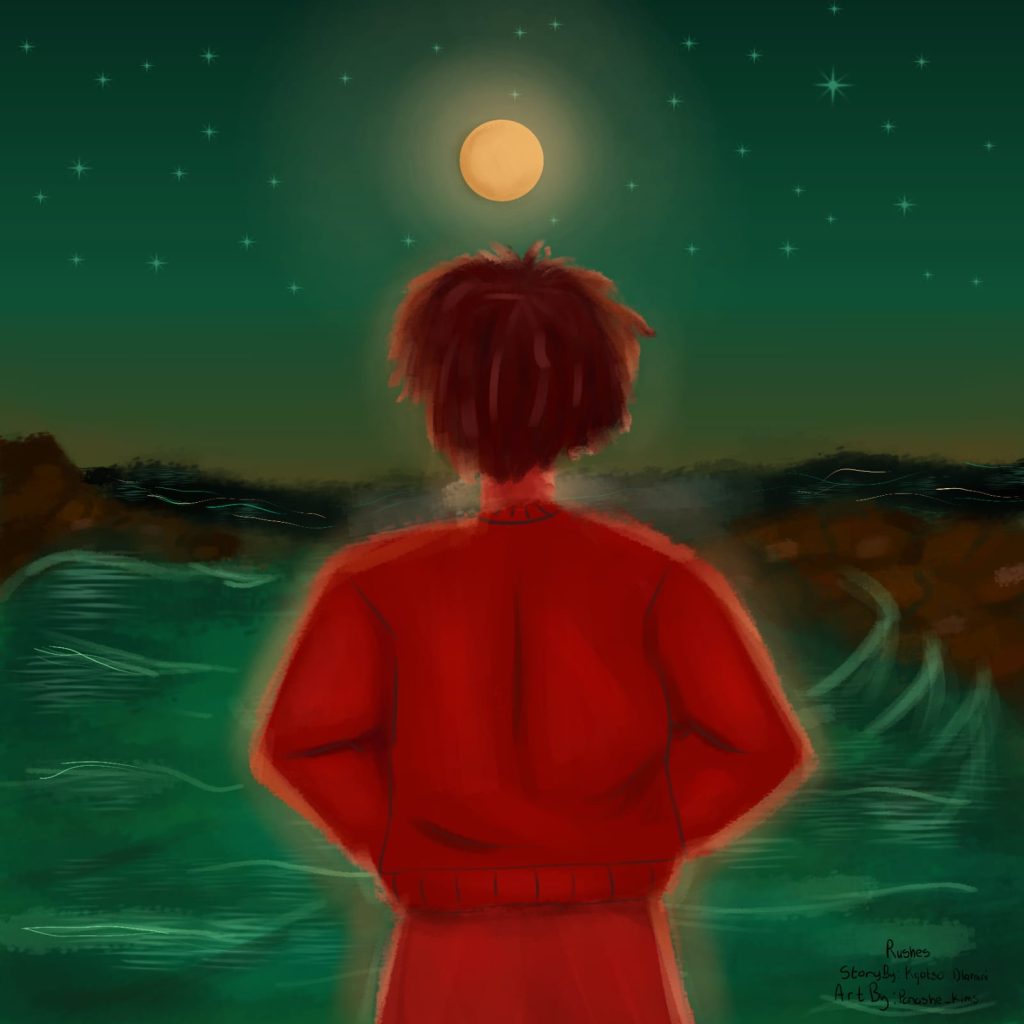
Artwork by Kimberly Panashe
My mind is spinning at a thousand kilometres per hour. I need to get this down before I forget it. Memories are so fickle. The fire burns brightest in the dark. I feel it clawing at me, trying to drag me back into that night. It’s all behind me. So are they.
A song I recognise blasts through the walls and the locked bathroom door as I study my own face in the mirror. The bleeding has stopped, but it’s left my white hoodie with a crimson collar. The song’s all wrong. Too fast, too loud, the words twisting into something I mistake for a message. I twist the tap closed, and the music goes with the running water. It slows down, softens.
The handle turns, the door turns, and someone walks in as if they twisted the key from the outside. He has a face I recognise, but introduces himself with a name that I don’t. “Don’t you remember me?” he asks. He tells me about some party and afterparty I never went to. All these places I can’t recall. He calls me by a name that’s not mine.
“I have to leave.” I push past him and, for an instant, it’s like I walk through him. I’m not here. This isn’t happening.
The counsellor looks down at his notepad and seems to erase something he wrote. “I’m confused,” he says. “Did the accident happen after that party?”
“I brought my own notebook,” I tell him and he exaggerates the look of concern on his face. To him, it’s as if it appeared out of nowhere, but I just pulled it out of my backpack. I wonder what he saw.
“Why?”
I shrug. “I don’t feel very comfortable when you scribble down whenever I’m talking. Let’s level the playing field.”
He says my name. “This is not a game.”
I smile and start writing down my own notes. “Of course not.” This office isn’t new to me, but some things are. A new plant in the corner of his room that reminds me of my girlfriend’s; a framed degree for the master’s he’s just completed; the figure standing by the door listening in and the way they duck down when I look directly at the looking glass.
“No, the accident wasn’t after that party. This is a whole other story.”
Strobe lights attack me after I shut the bathroom door behind me. I want to leave, but I hear a crowd chant my name and I get curious. I have to leave. My body starts moving in the direction of the noise, so I have no choice but to follow. Why can’t I leave?
The crowd is gathered around a table with plastic cups, and an empty bottle of vodka pointed at me. Someone slaps my shoulder and shouts. “You gotta go again!”
Someone else shoves a tray in my hands and I have to hold it, or it all falls down. “Pick your poison. Pill or potion.” they command.
I look down. The tray looks like something from my grandmother’s old house. Memories of small windows, snuff stained tissues, scraped knees, hearty meals and warm nights rush to my head. There’s a pale blue powder and a bottle of gin on the tray. None of that was in my grandma’s house. I let them take the tray and hug the bottle. The chant continues as I chug away. It tastes like cyanide.
Tonight, I feel like Kafka. The amount of white faces around me put it in perspective. I don’t know what town I’m in or whose party it is. I don’t know if the discomfort I feel is from the liquor or the people around me. White mouths saying black words, black voices speaking in white accents. Teenagers in their twenties with upper class drugs and alcohol. And now, it’s in my system too. I don’t belong.
The music rages on, the lights oscillate between reds, blues, shades and hues that feel like they mind blind me, the bodies go down, swing low, and move to a rhythm beyond me. I’m the only one not in the circle; out of the loop, unchained to the rhythm. Yet that feels like a cage of its own. Feet stomp, hands clap, voices sing all around me. It’s all a rush to the head. I find myself on the floor, ducked under a table, hugging the leg of a chair.
Then a hand reaches for me and touches my shoulder. “Do you wanna leave?” she asks. I look up and see three faces, Dahlia’s. I blink and they come together. “Right now?”
I say her name, like a question. “I do. I do.”
“You’re avoiding the matter of the accident,” my counsellor tells me. “And that’s what I wanna talk about.”
“Why?” I hiss, a little more aggressive than I intended to sound. “Why does the accident matter so much to you? It happened. People died. My brother died. Dahlia’s sister died. It’s over.” He backs away from me, in his luscious office chair that seems more comfortable than the couch I’m on. “Does this thing recline?” I ask.
“No.” He sighs. He says my name again. “You’re upset and aggressive. You make people uncomfortable and nervous. Paranoid, jumpy, nonverbal are some words some people close to you have used to describe you.”
“I’d say I’m pretty verbal. And what do you mean ‘some people close to me?’”
I remember meeting Dahlia at a group counselling session, back when we both lived in Durban, but I knew her before that. Before the accident, when my brother was dating her sister. I only ever saw her from a distance. I got into her high school in 11th grade and everyone had their cliques and social sites, and I never quite found my crowd. She could afford real therapy, but a bad experience in a one on one session led her down here, the tea room of an old church built by colonisers.
“How did they die?” she asked me, right in front of everyone. That was the first time she ever spoke to me. Months after the funerals, after the local news and gossip groups dragged our siblings’ names in the mud, and spoke of how reckless and careless ‘the youth of today’ was. She’d read the police reports, and the first responders had spoken to her and her mom, but she wanted to hear it from me.
All the faces in the room turned to me. Waiting, and waiting, and waiting. The memory came to me in flashes. Bodies covered in tarps, closed caskets, and lost futures. “They wouldn’t even let you see the bodies,” I said. “The car was a wreck. How do you think they died?”
Before the blues of the sirens, the fire burns red. I turn away from it and walk towards the dark. The ringing in my ears subsides, and my movement makes no sound. The sand below my feet is negligible. The whooshing wind is irrelevant. The waves lapping to and fro against the beach are all I see. The flames are all I hear. I keep moving forward, but I can’t escape it. I could have dragged their bodies out of the car with me, but I didn’t. Why didn’t I?
I keep on walking. I’ll let the water take me. I’ll let it carry me far from this place, from this dream, from this nightmare. I’ll disappear completely. This is atonement.
Dahlia pulls me from under the table when I finally let go of the chair. I need her support to get up onto my feet. She asks me if I have my phone and I hand it to her. “Let’s get a ride home,” she says before using my face to unlock it.
We make our way out of this maze of an apartment. I feel their eyes on me; looks of concern, looks of disgust. Their glares make my skin itch, and my fingers twitch, and my head hurt. Maybe it’s the liquor. Dahlia and I move in sync. I’m drunk, but I can tell she seems nervous, shaky. I wonder if I made her feel that way. “Are you okay?” I ask her.
She nods yes. “I’m just cold.” She puts the phone up to my face. “Two minutes away,” she tells me. I’ll be home soon. Home with her, away from the noise, away from the lights, away from the suffocating air of upper class animosity for black kids who don’t assimilate. I look at her and want to speak, but I’m in no state for a faux philosophical monologue or dialogue.
I press my head against her shoulder and close my eyes. I can feel her cold sweat through her top. She flinches when I touch her. “I love you,” I tell her.
There’s a pause before she says it back. “I love you, too.” I’ve never said those words to her before. Neither has she to me. A white car stops in front of us, and she opens the door for me. We get it and ride into the night. Away from the party life.
“Here’s my interpretation of the world,” I say to the counsellor, and he leans in. The room seems to lean in with him: the walls inching closer, the window focusing in, the light hum of the AC quiets down. Now, I have an audience. “We’re bogged down. The little light you have as a kid is dimmed as soon as you step into the ‘real world’, whatever that means. You’re not a kid anymore, and you’re supposed to find purpose. Find your wings, choose a political stance, curate your taste in media and clothes and sports, choose a religion, build a person to project out into the world, get a job, get paid, find love, start a family.” I pause to recollect my thoughts. He takes it as an opportunity to note something down. I wonder what it is. “All life is what we assume we’re meant to do with it from everyone that came before us. It takes a lot of effort, it takes guts, some luck, and opportunities. Not everyone has that luck, or the opportunities. Some of us get to start halfway up the mountains, some of us start at the bottom, some have to move mountains just to live. Just to breathe.”
I take a deep breath and the room inhales, and exhales with me. So does the counsellor. He continues writing up his profile of me.
“The harder it gets, the harder we seek out release,” I tell him. “Now, I’m not making up excuses for my substance abuse, or the isolation, or the failures and mistakes I’ve made as a new adult. I’m just thinking out loud.” I think about my mother, and how she spent a whole life with my father, a man who seemed to hate us, because a stable income household was better than a stable home. I think about the grief that paralysed her when my brother died, and how my sister and I couldn’t take care of her because we had our own lives to build. I think about all the decisions I made out of fear; of failure, of rejection, of ostracism, that led me to failure, rejection and ostracism anyways. I think of all the work I had to do to dig myself out of that hole of constant internal war, just to be defined by it anyways. First impressions are hard to let go of. “The world, as it is right now, was made to give us release. The catch is, it has a price tag. What do you do to get release when you can’t afford it the ‘right’ way? Whatever it takes.”
And that’s our time. I pack my bag in silence while the counsellor tells me we’re gonna need more sessions, that he still wants to completely understand me. I wonder if I’ll be able to ever completely understand myself. It’s a cold world outside. Everyone looks at me, until I look at them. They look over their shoulders, clutch their pearls, break their necks just to protect what’s theirs. For a lot of us, release is ownership – of thought, of taste, of things, of people. We do whatever it takes to get it, to keep it, because what do we have if we lose it all? I find my sister parked outside the building, lost in her phone, scrolling through something she’ll tell me about later. But before that, she asks me how the session went.
The Uber stops outside the house I share with three of my friends, and Dahlia thanks the driver. I’m too dazed to speak, half asleep, half alive. I don’t know what time it is. I want to ask what time it is, but as soon as I step out of the car, I buckle over and start puking all over the sidewalk. The driver leaves – this is none of his business. Dahlia leans over me and holds me by the shoulders, but there’s a hesitation in her movement. I look up at her and her face almost changes to something I can’t recognise.
“Get up,” she says, and the voice is hers. But something’s not quite right.
To see the whole world move without you feels like a daydream. A carousel of souls, and bodies, moving to a rhythm that feels second nature. Rinse and repeat. When grief strikes, you fall out of the loop. Time moves slow, but it still outpaces you. I wished the whole world would stop so I could take it all in, but it didn’t. It kept moving so, at first, I forced myself to move with it.
I felt as if I was in a perpetual state of fight or flight, so I flew away from it all. I ran. I ran so far away, but I could never get out of its reach. That crash, that smell of fuel and oil, that fire, that beach. At some point, I let it take me. When the water couldn’t save me, I let the grief consume me. It almost paralysed me, the way it did my mother, but I found ways to alleviate the pain. To keep it at an arm’s length. The parties, the substances, the jokes, the moments I let my soul leave my body so my flesh could rest from the weight of it all.
But, I can’t fly forever. I can’t run forever.
I’m weary, as Dahlia helps me into the house. My friends might be asleep, or out, or worried about me. She still has my phone, so I wouldn’t know if they called or texted. All the lights are off. No power, or no one home? I don’t know, and I don’t care. I need some water.
Muscle memory walks me through the house, while I mumble to Dahlia to make herself at home. She follows me into the kitchen and, as soon as I run the tap, she flicks the light switch on. The light is blinding, worse than the party, worse than the accident. No, not worse than the accident, but it feels like it. I’m losing my train of thought. There’s no glass under the tap, so the water just strikes the metal and it sounds like rainwater. I look at Dahlia and I can’t recognise the face I’m looking at. “Who are you?”
Dahlia followed me out of the church, the first time she spoke to me during the group therapy session. “Who are you?” she asked, after catching up and stopping in front of me.
I frowned. “What?”
“My sister used to tell me about you,” she said. “Nolitha said you were sweet, soft and careful when you spoke. That’s not what I just saw in there.”
I felt cornered, on a side walk in town where people would stop and stare whenever someone raised their voice. I managed to speak softly, but it may have come off more menacing than if I’d just let the emotions out. “Nolitha didn’t know me. You don’t know me. I don’t care what a dead person told you.”
She slapped me. Right then and there, a switch flipped inside of me, as they tend to. Not in therapy, not at the bottom of a bottle from a store that I knew wouldn’t ask for my age, not in any book I’d been told to read to ‘recover from the trauma.’ On the side of the road.
My immediate reaction was to scan for an escape route. People saw, people were watching, people were talking. The way they do, in soft voices, but loud enough so you can hear them, and they want you to. I jumped into a taxi that was dropping someone off the same road, not caring enough to know where it was going.
Dahlia didn’t follow me. I knew she wouldn’t. She had someone to pick her up. Good for her, I thought. She wouldn’t have to deal with the eyes of the people, who had something to talk about once they got home. Something new to spice up their mundane routines.
I sunk into the backseat after I paid, and the taxi took off. I couldn’t hide or run from the other passengers, but I could disappear from her view. Just for now.
If only I knew; that was only the beginning of this shitshow.

1 thought on “RUSHES 2026”
Lovely prose can not wait to read more