
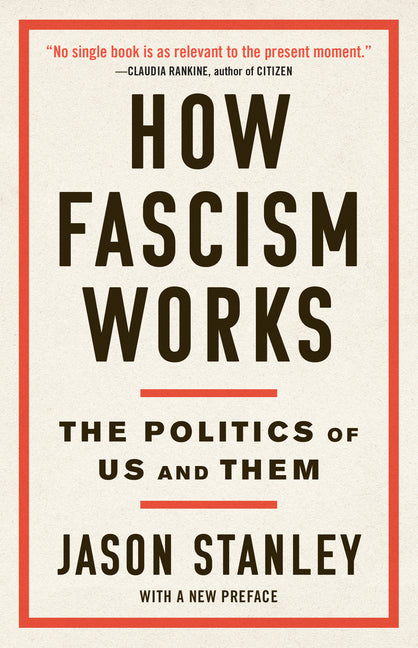
Jason Stanley’s How Fascism Works: The Politics of Us and Them is unsettling precisely because it does not treat fascism as a historical phenomenon. Published in 2018, the book examines fascism not merely as a political ideology attached to particular regimes, but as a collection of political techniques that can appear within democratic societies.
Stanley’s central concern is the way politicians construct an “us” and a “them” – a supposedly virtuous, authentic population threatened by an allegedly dangerous, corrupt or illegitimate minority.
The book is therefore less interested in defining fascism as a fixed political system than in identifying the mechanisms through which fascist politics can gain traction. Stanley examines nationalism, propaganda, anti-intellectualism, unreality, hierarchy, victimhood, law and order, sexual anxiety, and attacks on the legitimacy of democratic institutions. He argues that these elements can work together to turn political disagreements into an existential struggle between two groups.
The book’s strength lies in its emphasis on political psychology. In Stanley’s account, fascist politics does not depend entirely on convincing people of a coherent ideology. Instead, it can exploit emotions such as fear, resentment, humiliation and nostalgia.
The political message becomes something like: the real nation has been taken from you, and we can restore it by defeating those who stole it.
Fascism as a political method
One of Stanley’s most useful interventions is treating fascism as a political method rather than simply a historical ideology. Fascism is obviously associated with particular regimes, most notably Nazi Germany under Adolf Hitler, and Fascist Italy under Benito Mussolini. Still, Stanley is interested in the political techniques that made those regimes possible, which can, under different circumstances, appear in democratic politics. His argument is not that every society displaying nationalism, populism, or authoritarianism is therefore fascist. Rather, he asks what happens when several political strategies converge: the glorification of a supposedly authentic national identity, the creation of internal enemies, nostalgia for a hierarchical past, attacks on independent institutions, the manipulation of facts, and the presentation of political opponents as existential threats.
This distinction is important because it makes How Fascism Works less of a historical account of fascism and more of a framework for recognising political patterns. Stanley’s concern is ultimately democratic vulnerability. Fascism does not necessarily begin with the formal destruction of democratic institutions. It can begin with changes in political culture: with citizens being encouraged to distrust the press, dismiss expertise, regard minorities as threats, romanticise an imagined past, and understand political opponents not as fellow citizens but as enemies of the nation.
The strength of this approach is that it moves the reader away from simply asking whether a particular politician or movement is “fascist”. Instead, Stanley encourages us to ask what political work particular forms of rhetoric are performing.
The Politics of “Us” and “Them”
This brings the book to its central concern: constructing an “us” and a “them”.
For Stanley, fascist politics depend upon creating an idealised national community whose members are represented as authentic people. Against this stands an allegedly dangerous group blamed for the decline permeating our society. The identity of this group can vary. It might be immigrants (especially undocumented migrants), racial minorities (or historically disenfranchised racial groups), academics, feminists, LGBTQ+ people, or other groups portrayed as incompatible with the supposedly authentic nation.
What matters is not simply the existence of social divisions. Every society contains differences between groups. The political danger emerges when these differences become a hierarchy of belonging: some people become more authentically national than others, while particular groups are portrayed as inherently threatening.
Stanley is particularly interested in the way complex social problems can be converted into personalised explanations. Economic insecurity, crime, unemployment, declining public services or cultural change are difficult problems with multiple causes. Political rhetoric can make them easier to understand by finding someone to blame. The outsider becomes responsible for the insider’s problems.
This is one of the book’s most compelling ideas because it explains why political scapegoating can be effective even when the proposed explanation is inadequate. It provides an emotionally placating narrative: there is a problem, there is an enemy, and there is supposedly a politician capable of defeating said enemy.
Nostalgia and the Politics of Hierarchy
Stanley also identifies nostalgia as an important component of fascist politics. The past is presented as a period when society was supposedly more unified, orderly and morally coherent. Political change is then presented as decline.
But the past being invoked is rarely a complete historical reality. It is selective. It remembers the social position of those who benefited from existing hierarchies while minimising the experiences of those who were excluded from them.
This makes nostalgia politically significant, because it can disguise the restoration of hierarchy as the restoration of order.
The appeal is not necessarily “we should discriminate against this group of people”. It can instead be expressed through ideas such as “restoring tradition”, “returning to normalcy, or “taking the country back”. These phrases acquire political meaning through the question of what exactly is being restored, and whose social position is assumed to be the norm.
Stanley therefore links nostalgia to hierarchy. If a society’s imagined golden age was structured around unequal political, racial or gender relations, then longing for that “golden age” can also become a way of legitimising those relations.
Anti-Intellectualism, Propaganda and Unreality
Another major theme is the relationship between fascist politics and attacks on knowledge-producing institutions.
Stanley argues that universities, journalists, scientists, and other experts become targets because they provide alternative sources of authority. If citizens continue to trust independent institutions, then political propaganda has to compete with them. Undermining those institutions therefore weakens an important barrier to political manipulation.
This does not mean that every criticism of experts or institutions is inherently authoritarian. Democratic societies require criticism of institutions. Stanley’s point is more specific: a political movement becomes particularly dangerous when it systematically undermines the possibility of independent knowledge, especially when it dismisses evidence that contradicts its preferred narrative as inherently illegitimate.
His concept of “unreality” is particularly useful here. Political communities can develop competing versions of reality in which they accept or reject factual claims based on whether they support group identity. From there on, factual disagreement becomes inseparable from political loyalty.
The problem is therefore deeper than misinformation. A false claim can be corrected. A political culture in which people no longer accept any common authority capable of establishing facts is much more difficult to repair.
Law, Order and Victimhood
Stanley also examines the politics of law and order. Groups already constructed as threatening can then be presented as justification for increasingly punitive forms of state power. The supposedly ordinary citizen is positioned as the victim, while another group is represented as inherently dangerous.
Yet one of Stanley’s more interesting observations is that fascist politics can produce a sense of victimhood among groups that possess considerable social power.
The majority, or a historically dominant group, can be encouraged to believe that equality represents persecution. Social changes that expand the rights or visibility of previously marginalised groups can therefore be interpreted as an attack on those who were previously privileged.
This creates a political inversion. A group need not be objectively powerless to understand itself as under siege. Political rhetoric can transform the loss of privilege into the experience of oppression.
That insight is particularly relevant to Stanley’s discussion of gender and sexuality. Traditional hierarchies can be presented not as hierarchies at all, but as natural social arrangements being unfairly dismantled.
Gender, Sexuality and The Social Order
Stanley connects fascist politics to traditional ideas about gender, family and masculinity. The political defence of hierarchy frequently extends beyond race or nationality into the private sphere.
Women’s emancipation, feminism, and LGBTQIA+ equality can be represented as evidence that society has abandoned its “moral foundations”. The nuclear family becomes a symbol of national stability, while departures from traditional gender roles are treated as symptoms of cultural decline.
Again, the important issue is not whether someone personally values traditional family structures. Such values can exist within ordinary democratic politics. Stanley is concerned with what happens when particular familial arrangements are presented as the only legitimate expression of national identity, and those outside them are seen as threats to the social order.
This provides one of the book’s broader lessons: political hierarchy often survives by presenting itself as natural/innate.
How Far Does Stanley’s Framework Apply to South Africa?
South Africa provides an especially interesting test of Stanley’s framework because it has many of the social divisions around which “us” and “them” politics can be constructed, while also being a constitutional democracy explicitly founded on equality and human rights.
It would be an overstatement to describe South African politics as simply fascist. The country’s political system remains constitutionally democratic, with competitive elections, multiple parties, an independent judiciary, and constitutional protections for fundamental human rights. Freedom House continues to classify South Africa as a constitutional democracy, while also noting concerns surrounding corruption and institutional accountability.
Nevertheless, several of Stanley’s mechanisms appear in South African political discourse.
Immigration is the most immediate contemporary example I can think of. On 30 June 2026, thousands of people all over the country protested, demanding stronger action against undocumented immigration and increased deportations. Participants cited unemployment, pressure on public resources, and crime as reasons for stricter border control. The South African government has acknowledged concerns about illegal migration, border management, and pressure on public services. Still, President Cyril Ramaphosa has warned that anti-immigrant sentiment can be fuelled by misinformation and prejudice.
This is precisely where Stanley’s framework becomes useful – but also requires caution.
Concern about illegal migration is not inherently fascist. A sovereign state can regulate its borders, enforce immigration law, and debate the economic effects of migration within a democratic framework. Stanley encourages us to ask: what happens next? When migrants cease to be discussed primarily as a matter of immigration policy and instead become a generalised explanation for unemployment, crime, failing services, and a societal decline, the political “them” emerges.
South Africa’s history makes this particularly complicated because race, nationality and economic inequality overlap without being identical. Anti-immigrant rhetoric can target African migrants while drawing upon broader anxieties about scarcity and belonging. Recent protests demonstrate how easily genuine socioeconomic grievances can become attached to a particular out-group.
The politics surrounding race and land provides another useful comparison, albeit it should not be reduced to Stanley’s framework. South Africa’s racial inequalities are inseparable from colonialism and apartheid, and land reform remains an unresolved political and economic question. At the same time, recent tensions between South Africa and the United States have demonstrated how competing narratives about race can be constructed around the country. The Trump administration has portrayed South Africa’s affirmative-action and land policies as evidence of discrimination against white South Africans. At the same time, the South African government has argued that these policies are intended to address historical racial inequality.
This illustrates Stanley’s discussion of victimhood. A historically dominant group can experience contemporary policy changes as discrimination, while another political interpretation emphasises the continuing material consequences of historical racial domination. Stanley’s framework helps explain how politicians can construct competing “us” and “them” narratives from the same society.
However, this is also where the limitations of How Fascism Works become apparent. South African politics cannot simply be understood through a European fascism framework. The country’s political conflicts emerge from a distinctive history of colonialism, apartheid, racial capitalism, liberation politics, socioeconomic inequality, and constitutional transformation. Applying Stanley too mechanically could obscure those differences.
South Africa’s current coalition politics further demonstrates why the book should be used as an analytical framework rather than a label. Since the 2024 national elections, South Africa has operated under a Government of National Unity involving parties that historically competed against each other, while coalition politics have become increasingly significant ahead of the 2026 local government elections. The country’s political fragmentation can therefore produce conflict and polarisation, but it can also produce negotiation and institutional compromise.
In this sense, South Africa illustrates both the usefulness and limitations of Stanley’s arguments. His framework helps identify moments when politicians appeal to fear, resentment, exclusion, and nostalgia. Still, it does not, by itself, explain South Africa’s political system or determine whether a particular party or movement should be classified as fascist.
Strengths and Limitations
The greatest strength of How Fascism Works is therefore its ability to make political rhetoric more legible. Stanley gives readers a vocabulary for identifying recurring mechanisms: scapegoating, nostalgia, anti-intellectualism, unreality, hierarchy and victimhood.
Its principal weakness lies in the breadth of that vocabulary. Because many political movements can employ one or more of these techniques, readers may treat the framework as a checklist for identifying fascists rather than a tool for analysing political behaviour.
The distinction matters. Nationalism is not automatically fascist. Traditionalism is not automatically fascist. Criticism of academic elitism is not automatically fascist. Concern about immigration is not automatically fascist. Even aggressive political rhetoric is not automatically fascist.
The significance lies in how these elements interact and what political ends they serve.
Final Assessment
Ultimately, How Fascism Works is most valuable not because it gives readers a definitive list of contemporary fascists, but because it teaches them to pay close attention to how our political reality is constructed
Who belongs to the nation?
Who is excluded from it?
Who is portrayed as responsible for social decay?
Which version of history is worth remembering?
Which institutions are legitimate?
Who is the victim?
The book’s subject is fascism, but its deeper concern is democracy: the conditions under which citizens stop seeing one another as political opponents and begin seeing each other as enemies. Stanley’s warning is not that every political conflict presents the arrival of fascism; it is that democratic societies should pay attention when political competition increasingly depends upon defining some citizens as more humanly valuable or authentic than others.
For a book published in 2018, it remains strikingly relevant.